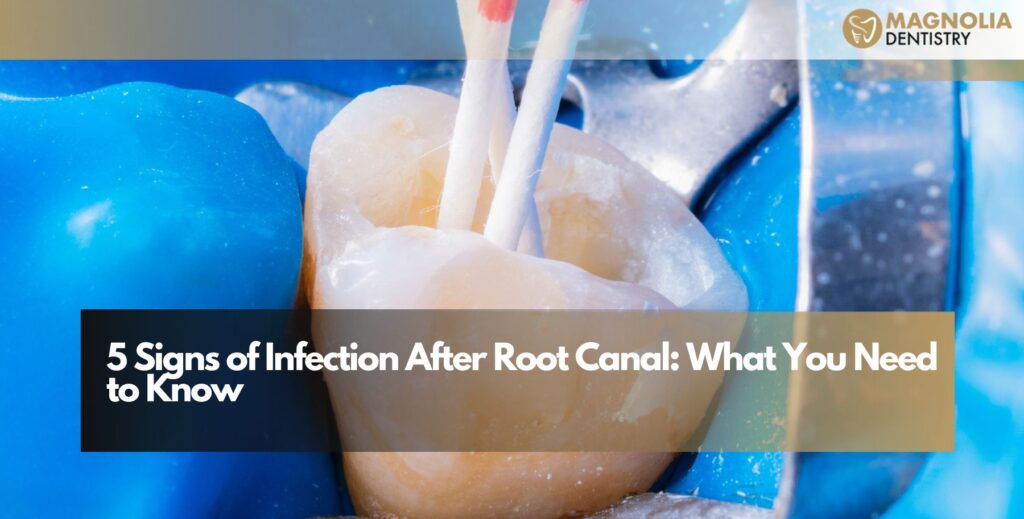
A root canal is designed to remove infection, relieve pain, and save a damaged tooth. Most treatments heal smoothly, but in some cases, bacteria can return and cause new or lingering symptoms. Recognizing the signs of infection after a root canal early is important because untreated infections can spread beyond the tooth and lead to serious complications.
This detailed guide explains the 5 major signs of root canal infection, why they happen, what they mean for your oral health, when you should seek help, and how dentists diagnose and treat a failed root canal. If you suspect something is wrong, do not wait.
Table of Contents
Why Does Infection Occur After a Root Canal?
A root canal infection can happen if bacteria remain inside the tooth or return later through a crack, faulty restoration, or deep decay. Even though root canals are highly successful, according to the American Association of Endodontists no treatment is 100% immune to complications.
Incomplete Removal of Bacteria
Sometimes, the root system is complex, curved, or unusually narrow. If all infected tissue is not fully removed, bacteria can survive and re-grow inside the sealed tooth.
New Decay Forms After Treatment
If decay develops near the original root canal area, bacteria can enter the sealed tooth and trigger a new infection. This is why regular dental checkups are essential after a root canal. See our guide on why regular dental checkups matter for your long-term dental health.
The Tooth Cracks After Treatment
Cracks allow bacteria to slip inside the tooth. Even small fractures are enough to cause a reinfection. A dental crown placed promptly after root canal treatment significantly reduces this risk.
Delay in Placing the Final Crown
A temporary filling does not protect the tooth long-term. If the final crown is delayed, the tooth becomes vulnerable to contamination and breakage, increasing the risk of a tooth infection after root canal treatment.
How to Tell If Your Root Canal Is Infected
Not all discomfort after a root canal signals a problem. Mild soreness for a few days is completely normal. However, if you notice any of the following, your tooth may have developed an infection that needs professional care immediately:
- Pain that gets worse instead of better after the first week
- Swelling in your gum, jaw, or face that does not go away
- A persistent bad taste or foul smell from the treated area
- A pimple-like bump or boil appearing on your gum near the tooth
- The tooth looks noticeably darker than surrounding teeth
- Fever or feeling generally unwell (sign infection may be spreading)
If you experience one or more of these symptoms, schedule an evaluation with a Dentist in Burbank, CA as soon as possible.
The 5 Major Signs of Infection After Root Canal
Below are the most common symptoms that indicate a root canal infection may be developing. If you notice any of these signs, it is important to seek dental care promptly.
1. Persistent or Increasing Pain After Treatment
Some discomfort after a root canal is normal, but it should steadily decrease with time. Pain that lingers for weeks or suddenly worsens is a warning sign.
- Mild soreness is expected, but if the pain continues beyond a week or intensifies, it may indicate that bacteria are still inside the tooth.
- Severe sensitivity to chewing or pressure often signals unresolved infection or inflammation of the surrounding bone.
- When infection spreads, it affects nearby nerves, causing pain that reaches beyond the treated tooth and sometimes into the jaw or ear.
- Throbbing pain that pulses without being touched is a classic sign of active infection or abscess formation.
If you had a root canal years ago and it suddenly starts hurting, do not dismiss it. Root canal infections can develop silently and emerge years after the original treatment. This is sometimes called a failed root canal.
2. Swelling in the Gums, Jaw, or Face
Swelling is one of the clearest signs that something is wrong after a root canal treatment.
- A raised bump, lump, or pimple-like spot on the gums may contain pus. This is known as a dental abscess.
- When infection spreads deeper into surrounding tissues, visible swelling may appear on the outside of the face or jaw.
- Swollen lymph nodes under the jaw or in the neck can indicate the infection is beginning to spread beyond the tooth.
- Even gentle pressure may feel painful because infection causes inflammation and increased blood flow to the affected tissues.
Facial or jaw swelling that develops rapidly alongside fever is a dental emergency. Seek care immediately as spreading infection can become life-threatening. This type of swelling is sometimes called symptoms of jaw infection after root canal.
3. Persistent Bad Breath or Metallic Taste
A lingering foul taste or metallic taste in the mouth that returns repeatedly can indicate active infection inside or around the tooth.
- If the root canal area forms an abscess, it may leak pus through the gumline, creating a bitter, sour, or metallic taste in the mouth.
- Active infection allows harmful bacteria to reproduce, causing strong odors that brushing alone cannot eliminate.
- When the bad taste returns frequently, especially in the morning, it signals infection that needs professional attention.
- A temporary filling that falls out from a root canal tooth can also produce a foul taste due to exposed internal material and bacteria.
A metallic taste after root canal treatment is one of the earliest signs that something is not healing correctly. Do not ignore it.
4. Tooth Discoloration or Darkening
While some teeth naturally darken slightly after a root canal, sudden or uneven discoloration can indicate deeper issues.
- If the treated tooth becomes significantly darker than surrounding teeth, it may signal internal breakdown or infection.
- Darkening around the gumline can indicate ongoing inflammation, early signs of gum disease, or poor healing.
- Gum discoloration around the treated tooth, such as a reddish or purplish tint, often points to active inflammation or abscess beneath the surface.
- Discoloration combined with pain or swelling strongly suggests a failed root canal that needs retreatment.
5. Formation of a Gum Boil or Pimple-Like Bump
One of the most common and obvious signs of a root canal infection is the appearance of a gum boil, also called a dental fistula. This is what a pimple on the gum after root canal typically looks like.
- The bump appears as a raised, rounded spot on the gumline, sometimes yellowish or white from pus, or red and inflamed.
- A gum boil may appear and disappear. It forms because the body creates a drainage pathway for infected fluid to escape.
- Even when the bump drains and seems to go away, the infection remains active inside the tooth root. It will return.
- A white bump on the gum after root canal or a painless bump on the gum after root canal should both be evaluated by a dentist promptly.
- A gum boil that keeps returning after draining is a strong indicator that bacteria remain inside the root canal system and treatment is needed.
Root Canal Infection Under a Crown: What You Should Know
Many patients assume a crowned tooth is fully protected. Unfortunately, infection can still develop under a crown years after root canal treatment.
- A crown covers the visible tooth but does not prevent bacteria from entering through tiny gaps, cracks, or secondary decay at the margins.
- Symptoms of infection under a root canal with a crown include swelling, persistent pain on biting, bad taste, and gum boils near the crowned tooth.
- If the crown is old or damaged, the seal may have weakened, allowing bacteria to re-enter the tooth root over time.
- Your dentist will use X-rays to check for bone loss or abscess formation below the crown without removing it.
- If infection is confirmed, root canal retreatment through the existing crown is often possible in many cases.
A crowned tooth that starts hurting, especially when biting, or shows gum swelling near it should be evaluated by your dentist without delay.
Root Canal Infection Years Later: Can It Happen?
Yes. Root canal infections can develop months or even years after the original procedure. This is more common than most people realize.
- A previously treated tooth may develop a crack over time, especially if it lacks a permanent crown, allowing bacteria to re-enter.
- New decay can form around the root canal filling or crown margin, creating a fresh pathway for infection.
- The original treatment may have left a tiny amount of bacteria that remained dormant and became active years later.
- Changes in immune health or new dental trauma can reactivate an old infection.
Warning signs of a root canal infection years later include sudden pain in a previously comfortable tooth, swelling of the gum near the old treatment site, or a new gum boil forming near the root canal tooth. If any of these develop, seek prompt care. Early intervention usually allows the tooth to be saved through retreatment.
How Dentists Diagnose Infection After a Root Canal
If you experience any symptoms from the list above, your dentist will perform several checks to confirm whether the tooth is infected.
Digital X-Rays
X-rays help identify bone loss, abscesses, or inflammation around the tip of the treated root. A dark area (called a periapical lesion) near the root tip is a common sign of infection on X-ray.
Gum and Tooth Examination
Your dentist will check for swelling, tenderness, gum boils, and any visible signs of infection at and around the treated tooth.
Temperature and Pressure Testing
If the tooth reacts strongly to biting pressure or temperature, it may indicate that the infection persists or that surrounding tissues are affected.
CBCT Imaging (3D Scan)
In complex cases, a cone-beam computed tomography (CBCT) scan provides a three-dimensional view of the tooth roots, surrounding bone, and any abscess formation that a standard X-ray might miss.
Treatment Options for a Root Canal Infection
If a root canal infection is confirmed, your dentist may recommend one of several treatment approaches depending on severity.
Root Canal Retreatment
This involves reopening the tooth, removing the old filling material, eliminating any remaining bacteria, and resealing the roots with a fresh, clean fill. Most infected root canals can be successfully retreated.
Apicoectomy (Root-End Surgery)
For stubborn infections that do not respond to retreatment, the dentist may surgically remove the infected root tip and seal the canal from the bottom end. This is typically performed by an endodontist.
Extraction and Tooth Replacement
If the tooth cannot be saved, removal may be necessary. Replacement options include dental implants, bridges, or partial dentures. Your dentist will discuss which option is best suited to your situation.
Antibiotics for Advanced Infection
Antibiotics help control swelling and systemic symptoms, especially if the infection shows signs of spreading. However, antibiotics alone are not a substitute for treating the source of infection inside the tooth. According to Mayo Clinic, a dental abscess must be drained and the source of infection addressed for complete resolution.
How to Prevent Infection After a Root Canal
Preventive steps and good aftercare help ensure long-term success after root canal treatment.
Follow Post-Treatment Instructions Carefully
Avoid chewing on the treated side until the permanent crown is placed. Use any prescribed medications as directed and report any unusual symptoms to your dentist promptly.
Keep Up With Oral Hygiene
Brush gently twice daily, floss daily, and use an antibacterial mouth rinse if your dentist recommends it. Good hygiene around the treated tooth helps prevent new decay and bacterial entry. Neglecting oral hygiene can lead to gum disease that can compromise even a previously successful root canal.
Do Not Delay the Final Crown
The final crown protects the tooth from cracking and prevents future bacterial entry. Delaying crown placement is one of the leading causes of root canal reinfection.
Regular Dental Visits
Routine checkups allow your dentist to monitor the treated tooth with periodic X-rays and catch any early signs of reinfection before they become serious. Learn what to expect at your next dental cleaning and checkup appointment.
Understanding the warning signs of infection can help you act quickly and protect your oral health. That is why our detailed guide on signs of infection after root canal treatment is designed to give you the clarity you need to identify symptoms and seek timely care.
Frequently Asked Questions About Root Canal Infection
How do I know if my root canal is infected?
The most common signs of an infected root canal include pain that gets worse instead of better, swelling in the gum or face, a persistent bad or metallic taste, a pimple-like bump on the gum, and tooth darkening. If you experience one or more of these symptoms, contact your dentist promptly for an evaluation and X-ray.
What does an infected root canal feel like?
An infected root canal often feels like a throbbing or constant ache that may radiate to the jaw or ear. Pressure from biting down on the tooth may be painful. In some cases a bump filled with pus forms on the gum. Some patients report a metallic or bitter taste and persistent bad breath that brushing does not resolve.
Can a root canal get infected years later?
Yes. A previously successful root canal can become infected years or even decades later if the tooth cracks, new decay forms at the crown margin, or the original restoration fails. Any sudden pain, swelling, or gum boil near an old root canal tooth should be evaluated by a dentist promptly.
Can a root canal get infected under a crown?
Yes. A crown covers the visible tooth but cannot fully prevent bacteria from entering through tiny gaps, old margins, or new cracks. If you notice pain, swelling, or a pimple on the gum near a crowned root canal tooth, have it checked. X-rays can detect infection under the crown without removing it.
What does a bump on the gum after root canal mean?
A bump or pimple on the gum near a root canal tooth is usually a dental fistula or abscess. It forms as the body creates a drainage channel for infected fluid. Even if it drains and disappears temporarily, the infection inside the tooth remains active and will return. This always needs professional treatment.
Is swelling after a root canal normal?
Mild swelling around the gum for 24 to 48 hours after root canal treatment is normal. However, swelling that worsens after the first two days, spreads to the face or jaw, or is accompanied by fever is not normal and requires immediate dental attention.
What is the difference between normal pain and infected root canal pain?
Normal post-treatment soreness is mild, localized to the tooth and gum, and steadily improves over 3 to 7 days. Infected root canal pain is often throbbing, may worsen when biting or at night, can radiate to the jaw or neck, and does not improve with time or over-the-counter pain relievers.
How is a root canal infection treated?
Depending on severity, treatment may include root canal retreatment (reopening and cleaning the tooth again), apicoectomy (surgical removal of the infected root tip), or extraction. Antibiotics may be prescribed alongside treatment to manage spreading infection but cannot resolve the problem on their own.
What happens if a root canal infection is left untreated?
An untreated root canal infection can spread to the surrounding bone, neighboring teeth, and soft tissues. In serious cases, the infection can form a dangerous abscess or spread to the jaw, neck, or airway. Early treatment is always far safer and less costly than waiting until the infection advances.
Can antibiotics cure a root canal infection?
No. Antibiotics can temporarily reduce swelling and prevent the infection from spreading but cannot eliminate the bacteria inside a sealed tooth. The source of infection must be addressed through retreatment, surgery, or extraction for a permanent resolution.
Why does my root canal tooth hurt when I bite down?
Pain on biting after root canal treatment can indicate lingering inflammation of the periodontal ligament (the tissue surrounding the root), reinfection, or a high bite where the crown or filling is slightly too tall. If biting pain persists beyond two weeks or returns months later, have your dentist check for infection or bite problems.
What does a metallic taste after root canal mean?
A metallic taste shortly after a root canal can come from the sealer or materials used and is usually temporary. A metallic or bitter taste that persists weeks later, especially combined with bad breath or gum swelling, may indicate that the temporary filling has failed or that pus from an abscess is leaking through the gumline.
How long should pain last after a root canal?
Mild soreness typically resolves within 3 to 7 days after a root canal. Some patients experience sensitivity for up to 2 weeks, especially to biting pressure. Pain that lasts longer than two weeks, increases in intensity, or returns after initially improving is a warning sign that should be evaluated by your dentist.
What are toxic root canal symptoms?
Some patients and researchers discuss the concept of toxic root canal symptoms, which refer to systemic effects such as fatigue, body aches, or recurring illness attributed to chronic low-grade infection from a failed root canal. While mainstream dentistry treats root canals as safe and effective, any chronic localized symptoms near a treated tooth should be evaluated with X-rays and clinical examination.
Conclusion
A root canal infection can be uncomfortable and concerning, but the signs are often easy to recognize when you know what to look for. Pain, swelling, discoloration, bad taste, and gum boils are all potential warning signals that the tooth may still be infected. Early diagnosis and treatment are essential to prevent complications and save your tooth.
If you suspect an infection or are experiencing any of the symptoms described, schedule an evaluation with a trusted Dentist in Burbank, CA for expert care and personalized treatment. Do not let a failed root canal go untreated. The sooner you seek help, the better your chances of saving the tooth and avoiding serious complications.