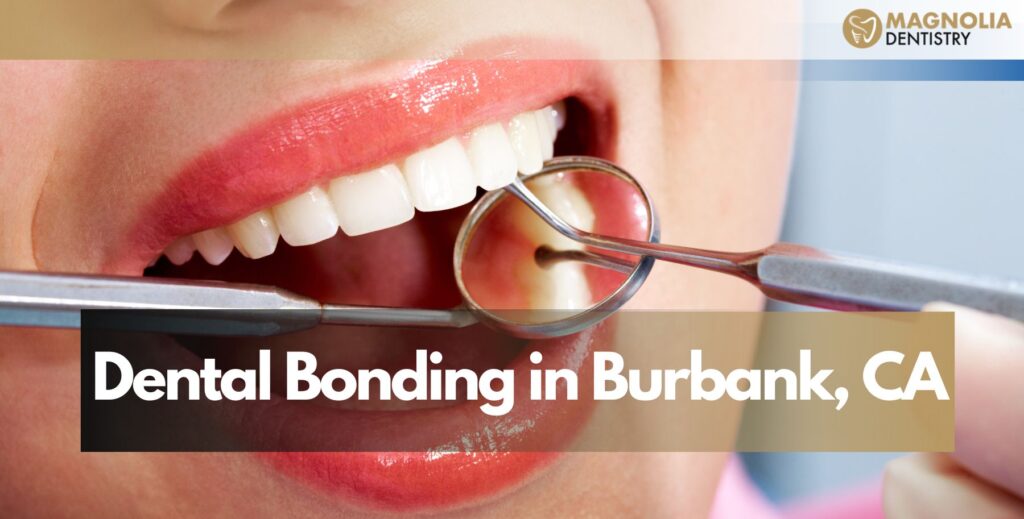
Dental bonding is one of the most practical cosmetic dental procedures Dr. Liyan Massaband, DMD, MPH offers at Magnolia Dentistry in Burbank, CA. In a single appointment, without drilling or anaesthetic in most cases, Dr. Massaband applies a tooth-coloured composite resin directly to the tooth surface and sculpts it by hand to correct chips, cover stains, close gaps, and reshape uneven teeth.
The result looks and feels completely natural. For patients who want to improve their smile without committing to veneers or orthodontic treatment, dental bonding delivers immediate, visible results at a fraction of the cost.
If you have a tooth that bothers you every time you see it in the mirror, dental bonding may be the most straightforward solution. Book your free bonding consultation: (818) 846-9041 | Mon-Fri 8AM-5PM
What Is Dental Bonding?
Dental bonding uses composite resin, a malleable tooth-coloured material made from a mixture of plastic and fine glass particles, to correct cosmetic and minor structural problems on natural teeth. The resin is applied in layers, sculpted to the desired shape using small instruments, and hardened with a curing light. Once set, it bonds permanently to the tooth surface.
Composite resin can be shaded precisely to match your surrounding teeth. In Dr. Massaband’s hands, the sculpting process is as much an art form as a technical procedure. The goal is always a result that integrates with your natural smile rather than standing out from it. Unlike dental veneers, which require laboratory fabrication and two appointments, composite bonding is completed chairside in a single visit. Unlike crowns, it requires no significant removal of tooth structure. This makes bonding the most conservative cosmetic option for patients who want improvement without alteration.
What Dental Bonding Can Fix
Dental bonding is a versatile treatment that addresses both cosmetic and functional concerns on natural teeth. Dr. Massaband uses bonding for the following situations:
Chipped or Cracked Teeth
A chip on a front tooth is one of the most common reasons patients come to Magnolia Dentistry for bonding. Dr. Massaband applies resin to rebuild the chipped edge, sculpts it to match the original tooth contour, and polishes it to the same sheen as your enamel. Most chip repairs take 30 to 45 minutes. You leave the same day with a tooth that looks whole again.
Tooth Discolouration and Staining
Some discolouration, particularly staining that has developed within the tooth structure due to antibiotics, fluorosis, or old restorations, does not respond to professional whitening. Bonding can cover these stains with a colour-matched layer of resin, creating a brighter and more uniform tooth appearance.
Note: if you plan to whiten your natural teeth, Dr. Massaband recommends whitening first. The bonding shade is then matched to your whitened teeth so everything looks consistent.
Gaps and Spaces Between Teeth
Small gaps between teeth, particularly the central incisors, can be closed with bonding without orthodontic treatment. Dr. Massaband adds resin to the sides of the adjacent teeth to reduce or eliminate the gap. This approach works best for small, localised gaps. Larger spacing issues are usually better addressed with orthodontics.
Uneven or Misshapen Teeth
Teeth that are shorter than their neighbours, pointed where they should be rounded, or simply oddly proportioned can be reshaped with bonding. Dr. Massaband adds volume where needed and sculpts the surface to improve symmetry. This is often used to create a more balanced appearance across the front teeth without any permanent alteration to the underlying tooth.
Exposed Roots and Gum Recession
When gum recession exposes the tooth root, the exposed area is vulnerable to sensitivity, decay, and further recession. Bonding can cover the exposed root surface, reducing sensitivity and protecting the root from temperature extremes and bacterial contact. This is a practical application of bonding with both functional and cosmetic benefit.
Small Cavities and Minor Decay
Composite resin is also the material used for tooth-coloured fillings. When a small cavity is detected early, Dr. Massaband removes the decay and restores the tooth with a composite filling that is shaded to match the surrounding enamel. The result is virtually invisible compared to older metal amalgam fillings.
The Dental Bonding Process at Magnolia Dentistry
Most dental bonding appointments at Magnolia Dentistry take between 30 and 60 minutes per tooth. The process is straightforward and comfortable for the vast majority of patients.
- Shade Selection: Dr. Massaband uses a shade guide to select the composite resin colour that most closely matches your natural tooth colour. In some cases, two or more shades are blended to achieve a more realistic result, particularly when the bonding covers a large area or when adjacent teeth have natural colour gradients.
- Tooth Preparation: For purely cosmetic bonding, anaesthetic is not needed in most cases. The tooth surface is lightly etched with a mild acid solution to create a texture that allows the resin to adhere securely. A bonding liquid (primer) is then applied to further improve adhesion. This preparation step takes only a few minutes and is completely comfortable for most patients.
- Applying and Sculpting the Resin: The composite resin is applied to the tooth and worked into shape while it remains in a soft, pliable state. Dr. Massaband sculpts the material by hand using fine instruments, building contour, edge detail, and surface texture to mimic natural enamel. This is the most technically and artistically demanding step of the process.
- Curing: Once the shape is correct, a focused blue-wavelength curing light is directed at the resin for 20 to 40 seconds. This triggers the hardening process, bonding the material permanently to the tooth surface. If multiple layers are used, each is cured before the next is applied.
- Finishing and Polishing: After curing, the bonded area is refined with fine-grit finishing discs and polishing burs to achieve a smooth surface and a natural sheen. The bite is checked and adjusted if needed. The appointment ends with a final review in a mirror so you can see and confirm the result before leaving.
Dental Bonding vs Veneers Which Is Right for You?
Both composite bonding and porcelain veneers correct cosmetic problems on front teeth. Understanding the differences helps you make an informed decision at your consultation.
Dental Bonding
- Material: composite resin applied directly to the tooth
- Appointments: completed in one visit, no laboratory required
- Reversibility: the natural tooth structure is essentially unchanged and bonding can be removed
- Longevity: typically 5 to 8 years with careful maintenance
- Cost: from $300 to $600 per tooth
- Best for: single chips, small gaps, minor discolouration, reshaping one or two teeth
Porcelain Veneers
- Material: thin custom-fabricated ceramic shells cemented to the front of the tooth
- Appointments: requires two appointments and a laboratory fabrication period
- Reversibility: a small amount of enamel is permanently removed during preparation
- Longevity: 10 to 20 years with proper care
- Cost: from $900 to $2,000 per tooth
- Best for: multiple teeth, complete smile transformation, severe discolouration
Dr. Massaband recommends composite bonding as the starting point for most patients with minor concerns on one or a few teeth. If your goal is a complete smile transformation covering six to eight front teeth, veneers typically produce a more durable and aesthetically consistent result. Both are discussed at your free consultation.
Are You a Good Candidate for Dental Bonding?
Most adults with minor cosmetic concerns on their natural teeth are good candidates for dental bonding. Dr. Massaband evaluates each patient’s teeth, gum health, and bite before recommending bonding to confirm it is the most appropriate solution.
Dental bonding works well for:
- Patients with minor chips, cracks, or surface irregularities on natural teeth
- Patients with small localised gaps between teeth
- Patients with staining that does not respond to whitening
- Patients who want a single-appointment cosmetic improvement
- Patients who prefer a reversible option before committing to veneers
- Patients with exposed roots causing sensitivity
Bonding is not the ideal choice if:
- The tooth has extensive decay, fracture, or structural damage that requires a crown
- Significant bite force or grinding is present (bruxism can chip bonding material)
- The cosmetic concern affects six or more front teeth (veneers produce better long-term results)
- Active gum disease or untreated cavities are present (these must be treated first)
If bonding is not the right solution for your situation, Dr. Massaband will tell you clearly and explain what will work better. The goal is always the treatment that serves your long-term oral health and appearance, not just the simplest option.
How Long Does Dental Bonding Last?
Composite resin bonding typically lasts between 5 and 8 years before it needs to be refreshed or replaced. Some patients maintain their bonding for 10 years or more with careful habits. The longevity depends on three main factors: where the bonding is placed on the tooth, the biting forces it is exposed to, and your daily maintenance habits.
Habits that extend the life of your bonding:
- Brush twice daily with a soft-bristled toothbrush and non-abrasive toothpaste (avoid whitening toothpastes with harsh abrasives, which can dull the resin surface)
- Floss daily, paying attention to the gum margins around bonded teeth
- Avoid biting hard objects directly on bonded teeth: ice, pens, hard sweets, fingernails
- Do not use bonded teeth to open packaging, bite nails, or cut thread
- Attend 6-month professional cleanings so Dr. Massaband can monitor and polish the bonded areas
- Wear a custom night guard if you grind your teeth, as grinding is the most common cause of premature bonding failure
Composite resin is more susceptible to staining than porcelain. Limiting coffee, tea, and red wine, or rinsing with water after consuming them, helps maintain the colour of your bonding over time. If a bonded tooth chips or the resin partially comes away, contact Magnolia Dentistry promptly. In most cases the repair is simple and quick.
Dental Bonding Cost in Burbank, CA
Dental bonding is one of the most affordable cosmetic dental procedures available. At Magnolia Dentistry, the cost depends on how many teeth are being treated and the extent of the bonding required for each tooth.
General price ranges at our Burbank practice:
- Single-tooth cosmetic bonding: $300 to $600 per tooth
- Multiple teeth (3 or more): discussed at consultation with package pricing available
- Composite filling (decay-related bonding): $150 to $350 per tooth, typically partially covered by dental insurance
Does insurance cover dental bonding?
Cosmetic bonding that is purely aesthetic (closing a gap, reshaping a tooth) is generally not covered by dental insurance. Bonding used to restore a tooth damaged by decay, fracture, or trauma may qualify for partial coverage under basic restorative benefits. Our team checks your specific coverage before your appointment.
Compared to porcelain veneers ($900 to $2,000 per tooth), composite bonding is significantly more affordable and requires no laboratory fees. For patients who want to improve one or two teeth without a major investment, bonding is almost always the right first step.
Get your exact cost at your free consultation: (818) 846-9041
Why Choose Dr. Massaband for Dental Bonding in Burbank?
Dental bonding done well is an art form. The quality of the result depends on the clinician’s eye for proportion, their understanding of how light interacts with resin, and their ability to sculpt a convincing tooth shape freehand. Dr. Liyan Massaband, DMD, MPH approaches every bonding case with the precision and attention to detail that patients notice when they see the result.
- DMD (Doctor of Dental Medicine) + MPH (Master of Public Health) credentials
- 15 or more years of cosmetic and restorative dental experience in Burbank, CA
- Careful shade matching using multi-shade blending for the most natural result
- Conservative approach: the minimum amount of tooth alteration needed to achieve the desired outcome
- Free consultation with a clear written cost estimate before any commitment
- Transparent about when bonding is and is not the right choice for your situation
- 4.8-star rating from more than 350 verified Google reviews
‘I approach bonding as a precision exercise. Getting the contour, surface texture, and sheen right requires close attention and time. I never rush it, because the result is what you will see every day.’ Dr. Liyan Massaband, DMD, MPH
Frequently Asked Questions About Dental Bonding in Burbank
How long does dental bonding last?
With proper care, composite resin bonding lasts between 5 and 8 years for most patients. Some patients maintain their bonding for 10 years or more by avoiding hard foods on the bonded teeth, wearing a night guard if they grind, and attending 6-month professional cleanings. When the resin eventually wears, chips, or discolours, it can be refreshed or replaced in a single appointment.
Does dental bonding hurt?
For purely cosmetic bonding, anaesthetic is not needed in most cases. The tooth preparation step, which involves applying a mild conditioning gel to the surface, is completely painless. When bonding is used to treat a cavity, a small amount of anaesthetic is used to ensure comfort during decay removal. Most patients describe the bonding procedure as very comfortable compared to other dental treatments.
Can bonded teeth be whitened?
No. Composite resin does not respond to teeth whitening treatments. The colour of the resin is fixed at the time of application. If you are planning to whiten your teeth, the correct sequence is to whiten first and then match your bonding shade to the whitened colour of your natural teeth. If you whiten after bonding, the resin will appear darker than the surrounding teeth.
How do I care for bonded teeth?
Brush twice daily with a soft toothbrush and non-abrasive fluoride toothpaste. Floss daily. Avoid biting hard objects (ice, pens, hard sweets, nails) with the bonded tooth. Limit staining drinks such as coffee and red wine, or rinse with water after consuming them. Attend 6-month cleanings so Dr. Massaband can polish and assess the bonded areas. If you grind your teeth, wear a custom night guard to protect the resin from fracture.
Is dental bonding reversible?
Yes. Because composite bonding requires minimal or no enamel removal, the natural tooth structure remains essentially intact. If you later decide to replace bonding with veneers, crowns, or simply remove it, the tooth underneath is preserved. This makes bonding an excellent starting point for patients who want improvement but are not yet ready to commit to a more permanent treatment.
How much does dental bonding cost in Burbank, CA?
Cosmetic dental bonding at Magnolia Dentistry ranges from $300 to $600 per tooth, depending on the extent of the treatment. Composite fillings (bonding used to treat decay) are typically less expensive and may be partially covered by dental insurance. A written cost estimate is provided at your free consultation before any treatment begins. Call (818) 846-9041 to book.