Author: Dr. Liyan Massaband, DDS | Magnolia Dentistry, Burbank, CA
Medically Reviewed: June 2026 | Reading Time: 8 min
Quick Summary: Dental implants have one of the highest success rates of any surgically placed device in medicine, 95 to 98% over ten years, but failures do occur, and knowing the warning signs early makes a significant difference to the outcome. This guide explains the difference between early and late implant failure, the 7 most common signs your implant may be failing, the real reasons implants fail (including several that most patients are never told about), and what your options are if a failed implant needs to be removed and replaced.
What Is Dental Implant Failure?
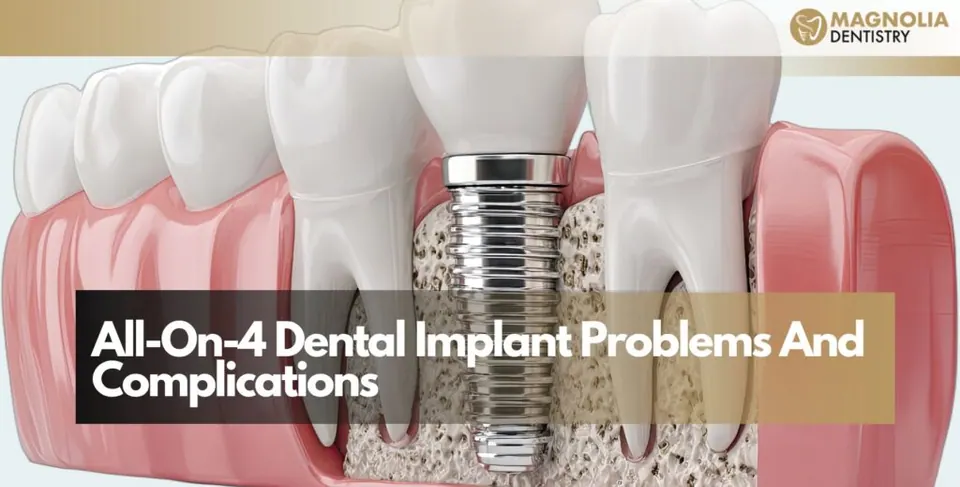
A dental implant fails when it loses its integration with the surrounding jawbone and can no longer function as a stable, load-bearing anchor for the crown, bridge, or denture it supports.
The technical term for the bond between implant and bone is osseointegration, the direct structural and functional connection between living bone tissue and the titanium implant surface. When osseointegration is achieved successfully, the implant becomes as stable as a natural tooth root. When osseointegration fails to develop, or breaks down after initially forming, the implant becomes mobile, eventually painful, and must be removed.
It is important to distinguish implant failure from implant complications. A complication, such as a cracked crown, a loose abutment screw, or temporary nerve sensitivity, affects the components attached to the implant but does not necessarily mean the implant itself has failed. True failure means the titanium post itself is losing or has lost its connection to the bone.
The distinction between these two categories matters because complications can often be repaired without removing the implant, while implant failure typically requires removal, a healing period, and reassessment before any replacement procedure.
For context on the broader concerns patients have about dental implants, our guide on side effects of dental implants covers both expected post-procedural symptoms and the signs that indicate something more serious is occurring.
Early vs Late Implant Failure: What Is the Difference?
Timing is one of the most clinically useful ways to categorize implant failure because the cause, and therefore the response, differs significantly between the two.
Early Implant Failure (0 to 3 Months Post-Placement)
Early failure occurs during the osseointegration period, the weeks immediately following surgical placement when bone is actively growing into and bonding with the implant surface. If this process is disrupted, the implant never fully bonds and remains unstable.
Early failure is typically detected within 3 months of placement. The most common presentations include persistent pain and sensitivity at the implant site beyond the expected healing period, mobility of the implant itself (not just the crown), and failure to achieve primary stability during placement.
Early failures are generally associated with:
- Surgical placement errors or contamination
- Insufficient bone volume or density at the time of placement
- Patient health conditions that impair bone healing
- Immediate loading before osseointegration is complete
- Infection introduced at or shortly after placement
Late Implant Failure (3 Months to Years After Placement)
Late failure occurs after osseointegration has already been achieved successfully. Something disrupts the established bone-implant interface over time, causing the bond to break down progressively.
Late failures can occur anywhere from 3 months to 15 or more years after placement. The most common cause by a considerable margin is peri-implantitis (detailed below). Late failures can also result from mechanical overload, parafunctional habits like bruxism, and certain systemic conditions.
Key clinical point for patients: An implant that felt perfectly stable and comfortable for years can still develop late failure. A sudden onset of any of the signs listed below in a previously asymptomatic implant warrants prompt evaluation, regardless of how long the implant has been in place.
Timeline at a Glance:
| Timeframe | Phase | Most Common Cause |
|---|---|---|
| 0 to 4 weeks | Surgical healing | Infection, poor primary stability |
| 1 to 3 months | Osseointegration | Failed bone integration, early loading |
| 3 to 12 months | Early function | Occlusal overload, early peri-implant disease |
| 1 to 5+ years | Long-term function | Peri-implantitis, bruxism, systemic factors |
The 7 Most Common Signs Your Implant May Be Failing
These signs apply to both early and late failure. Some overlap with normal post-surgical symptoms in the first weeks, which is why timing and severity both matter when interpreting them.
Sign 1: Persistent Pain or Throbbing at the Implant Site
Some discomfort is completely expected in the first 3 to 7 days after implant placement surgery. What is not normal is pain that does not improve after the first week, or pain that returns after a period of comfortable healing.
Persistent throbbing or aching at an implant site, particularly pain that appears unprovoked or that wakes you at night, can indicate infection, failed osseointegration, or developing peri-implantitis. This is the most common presenting complaint in implant failure cases.
Sign 2: Implant Mobility, Even Slight Movement
A successfully integrated dental implant should feel as stable as a natural tooth. Any detectable movement of the implant itself is abnormal and requires immediate evaluation. Even slight rocking or rotation when you bite or press on the implant indicates the bone-implant interface has been lost or is severely compromised.
It is worth noting that a loose crown or loose abutment screw can mimic implant mobility. Your dentist can quickly determine which component is actually moving. If the crown is loose but the implant itself is stable, the fix may be straightforward. If the implant itself is mobile, the situation is more serious.
Sign 3: Swelling, Redness, or Bleeding Around the Implant
Redness and slight swelling in the first few days after surgery are expected as the tissue heals. What is not normal:
- Swelling that increases after the first week rather than improving
- Gum tissue that bleeds consistently when you brush or floss around the implant
- Bright red or noticeably inflamed gum tissue around the implant collar more than two to three weeks after placement
- A visible gap forming between the implant crown and the gum tissue
These signs indicate peri-implant mucositis (early, reversible gum inflammation) or more advanced peri-implantitis. The early, reversible stage can be treated successfully without implant loss, which is why acting quickly on these signs matters.
Sign 4: Pain When Biting or Chewing
An implant that has successfully integrated and is properly loaded should not cause pain during normal biting and chewing. If chewing on the implant side produces pain, this can indicate:
- A bite height problem where the implant crown is too tall (occlusal interference), causing excessive force on the implant
- Failed osseointegration where the bone-implant interface has not formed properly
- An infection spreading from the implant into surrounding bone
- A cracked or fractured implant component
Bite-related pain that develops gradually over weeks or months in a previously comfortable implant is often an early sign of progressing peri-implantitis eroding the bone support.
Sign 5: A Persistent Bad Taste or Unpleasant Odor Near the Implant
A foul or metallic taste that does not resolve with normal brushing and flossing near an implant site is a reliable sign that bacteria are accumulating in a pocket around the implant. This is typically caused by peri-implant disease or an incompletely sealed junction between the implant crown and the implant body, which allows bacteria to colonize the gap.
Pus drainage from the gum around the implant, which produces both a bad taste and visible discharge, indicates active infection and requires same-day dental evaluation.
Sign 6: Recession of the Gum Tissue Around the Implant
The gum tissue around a successful implant should remain stable. Progressive recession, where the gumline around the implant appears to be pulling back, exposing more of the implant collar or the crown margin, can indicate:
- Loss of the underlying bone that supports the gum tissue
- Excessive pressure from a poorly fitting crown or prosthesis
- Early stages of peri-implantitis
Visible recession around an implant that was not present at the time of crown placement should always be evaluated. It is often the visible indicator of bone loss that has been occurring invisibly below the gumline.
Sign 7: Nerve-Related Symptoms, Numbness, Tingling, or Burning
Numbness, tingling, or a burning sensation in the lip, chin, tongue, or gum tissue near the implant can indicate that the implant was placed close to a nerve, or that swelling from infection is placing pressure on a nearby nerve. This symptom can appear immediately after surgery if the placement was too close to the inferior alveolar nerve, or it can develop later if infection and swelling compress the nerve.
Nerve symptoms should always be reported to your dentist promptly. Many cases resolve as inflammation decreases, but persistent nerve involvement may require imaging to assess the implant position and determine whether repositioning or removal is necessary.
Why Do Dental Implants Fail? Top Causes
1. Peri-Implantitis
The leading cause of late implant failure. Covered in detail in its own section below.
2. Failed Osseointegration
When the bone does not successfully integrate with the implant surface during the healing phase, the implant has no stable anchorage. This is the most common cause of early failure. Risk factors include poor bone quality, insufficient bone volume at the placement site, surgical contamination, and premature loading before healing is complete.
3. Smoking
Smoking impairs circulation, reduces the oxygen supply to healing tissues, and diminishes the immune response to bacterial infection, all of which compromise both initial healing and long-term implant maintenance. A meta-analysis in Clinical Oral Implants Research, cited by multiple peer-reviewed sources, found that implant failure in smokers is approximately twice as likely compared to non-smokers.
4. Uncontrolled Diabetes
Poorly controlled blood sugar impairs wound healing, reduces resistance to infection, and affects bone quality and turnover. Research indicates that uncontrolled Type 2 diabetes increases the risk of peri-implant disease by approximately 2.75 times compared to patients with well-controlled or no diabetes. Patients with well-managed diabetes, however, have implant success rates comparable to non-diabetic patients, the key variable is glycemic control.
5. Certain Medications
This is the category most competitor pages either miss entirely or cover superficially. Three medication classes deserve specific mention:
- Bisphosphonates (used for osteoporosis, Paget’s disease, and some cancers): These drugs alter normal bone remodeling and can impair the bone’s ability to form the integration needed around an implant. Research published in PMC (NIH) indicates bisphosphonate use increases peri-implant disease risk by approximately 2.69 times, and the American Academy of Implant Dentistry recommends thorough risk assessment for patients on long-term bisphosphonate therapy before implant placement.
- SSRIs (selective serotonin reuptake inhibitors): Research from the Academy of Osseointegration indicates SSRI use is associated with a 6.28-fold increase in peri-implant disease risk, likely through effects on bone metabolism and serotonin’s role in osteoblast function.
- Long-term NSAIDs: Short-term use does not appear to affect osseointegration, but long-term or high-dose use may impair the bone remodeling required for sustained implant integration.
Patients on these medications are not necessarily poor implant candidates, but risk must be assessed and discussed transparently before surgery.
6. Bruxism (Teeth Grinding)
Excessive, repetitive occlusal forces from grinding or clenching transmit directly to the implant and surrounding bone. Unlike natural teeth, which have a periodontal ligament that acts as a shock absorber, implants are rigidly anchored in bone with no cushioning mechanism. Chronic overloading from bruxism can fracture implant components, loosen abutment screws, and progressively destroy the crestal bone that supports the implant.
Patients who grind their teeth should discuss this with their implant dentist before placement. A custom occlusal night guard is typically recommended as a protective measure.
7. Residual Dental Cement
One overlooked cause of peri-implant disease: excess cement left in the gum tissue during crown cementation. A peer-reviewed review found that excess cement was present in 81% of sites showing clinical signs of peri-implant disease. Cement trapped under the gumline becomes a bacterial trap, fueling exactly the type of chronic infection that destroys bone around implants. Screw-retained crowns (where the crown is secured with a screw rather than cement) eliminate this risk entirely.
8. Insufficient Bone Volume or Quality
An implant placed in bone that lacks adequate width, height, or density may never achieve stable osseointegration, or may lose stability over time as bone remodels. This is why pre-implant bone grafting is sometimes necessary. Our guide on bone grafting for dental implants explains when grafting is needed and what the procedure involves.
Implant Failure Rate: What the Research Shows
Context matters enormously here, and most patients deserve honest statistics rather than either false reassurance or unnecessary alarm.
The overall picture is strongly positive:
- Dental implant survival rates of 95 to 98% at 10 years are consistently reported across major clinical studies, according to research funded by the National Institute of Dental and Craniofacial Research
- A 22-year cohort study reported a cumulative survival rate of approximately 96.8% at 10 years and 94% at 15 years
- The vast majority of implant patients, well over 95%, never experience failure
The picture is more nuanced for specific populations:
- Smokers have approximately double the failure rate of non-smokers
- Patients with uncontrolled diabetes have significantly higher complication rates
- Patients with a prior history of periodontal disease have higher rates of peri-implantitis and implant-associated bone loss
- Upper jaw (maxillary) implants have slightly lower success rates than lower jaw (mandibular) implants, due to lower bone density in the maxilla
The important takeaway: dental implants are highly reliable for the right patient in the right clinical situation. Failure is not inevitable, but it is real, it happens, and knowing the signs allows you to act before the situation becomes irreversible.
Peri-Implantitis: The Leading Cause of Late Failure
Peri-implantitis deserves its own dedicated section because it is responsible for the majority of late implant failures and is far more prevalent than most patients are told before their procedure.
Peri-implantitis is a bacterial infection of the gum tissue and bone surrounding an osseointegrated implant. It is structurally analogous to periodontitis (gum disease) in natural teeth, but it progresses faster and is more destructive, primarily because implants lack the periodontal ligament that in natural teeth provides some biological buffer against bacterial invasion.
How common is peri-implantitis?
This is where the research is sobering. Meta-analyses published in peer-reviewed journals report patient-level prevalence rates of approximately 22% for peri-implantitis and 43% for peri-implant mucositis (the earlier, reversible stage). In patients with a prior history of periodontal disease, these rates are meaningfully higher.
The two-stage progression:
- Peri-implant mucositis: Inflammation is confined to the soft tissue (gum) around the implant. Bone has not yet been affected. This stage is reversible with professional cleaning, improved home care, and where indicated, antimicrobial treatment. Catching the condition at this stage preserves the implant fully.
- Peri-implantitis: Inflammation has progressed to involve the bone surrounding the implant. Bone loss is occurring. This stage is not reversible — lost bone does not regenerate spontaneously — but it can be arrested with treatment, and bone regeneration procedures may partially restore lost support in suitable cases.
Signs of developing peri-implantitis:
- Gum tissue around the implant that bleeds when brushed or probed
- Redness or swelling of the peri-implant gum tissue
- A bad taste or odor near the implant that persists despite oral hygiene
- Visible pus from the gum around the implant
- Progressive recession of the gum and bone around the implant
- Increasing mobility of the implant itself in advanced cases
The critical window: Peri-implant mucositis treated promptly does not become peri-implantitis. Once peri-implantitis develops, it can be managed but not fully reversed. Once peri-implantitis causes enough bone loss to compromise implant stability, removal becomes necessary. Attending your regular dental maintenance appointments is the single most effective protection against reaching this point.
Can a Failed Implant Be Replaced?
In most cases, yes, but with important conditions.
When an implant fails and is removed, several things must occur before a new implant can be placed:
- The failed implant is removed. This is typically a straightforward procedure performed under local anaesthesia, involving either reverse-torquing the implant out or, in cases where the implant is infected and surrounded by soft tissue, a minor surgical approach.
- The site is thoroughly debrided. All infected tissue, biofilm, and debris are removed from the socket to create a clean environment for healing.
- Bone grafting may be required. If the failed implant caused significant bone loss around the site, a bone graft is typically placed at the time of removal, or at a separate procedure, to rebuild the bone volume needed to support a new implant. See our guide on bone grafting for dental implants for what this procedure involves.
- A healing period is observed. Typically four to six months of healing is allowed before a new implant is placed. This ensures the site is fully healed and any previous infection has resolved.
- Risk factors are addressed. If smoking, uncontrolled diabetes, medication issues, or bruxism contributed to the first failure, these should be optimized before attempting replacement. An implant placed into the same environment that caused the first failure has a much higher probability of failing again.
Replacement implants have generally good success rates when the underlying risk factors are properly addressed. Outcomes are better when the failure was early (less bone loss) and when the patient and dentist together identify and mitigate the cause.
For a full overview of what to expect after implant removal, see our page on what to expect after removing a dental implant.
How to Prevent Implant Failure
The majority of implant failures are preventable. Here is what the evidence and clinical practice support most strongly.
Before placement:
- Choose a dentist with specific, documented implant experience and appropriate case volume
- Ensure thorough pre-surgical assessment including 3D CBCT imaging to evaluate bone volume, density, and anatomy before placement
- Disclose all medications, including bisphosphonates and SSRIs, fully and accurately
- Achieve good control of blood sugar if you have diabetes before proceeding with surgery
- Quit smoking or significantly reduce tobacco use before and after surgery, failure rates in smokers are roughly double those of non-smokers
During healing:
- Follow all post-surgical care instructions precisely, the osseointegration period is when the implant is most vulnerable
- Avoid loading the implant with hard food or any biting pressure before your dentist confirms integration
- Attend all follow-up appointments as scheduled
Long-term maintenance:
- Brush twice daily using a soft-bristle brush and floss daily around the implant using implant-specific floss or an interdental brush
- Attend professional cleaning appointments at least every six months, more frequently if you have a history of gum disease
- Wear a custom night guard if you grind your teeth
- Report any of the 7 signs described above promptly, do not wait for a scheduled appointment if you notice swelling, pain, or changes around your implant
Our page on All-on-4 dental implants in Burbank outlines the specific maintenance protocols and follow-up care we provide for implant patients at Magnolia Dentistry. Implant problems caught early are implant problems solved with far less complexity and cost.
FAQs
What does dental implant failure feel like?
The most common sensation is persistent pain or throbbing at the implant site that does not improve after the normal healing period, or that appears in a previously comfortable implant. Some patients notice mobility — a subtle rocking or shifting when they bite. Others have gum swelling, a bad taste, or bleeding when they brush near the implant. Some late failures develop with minimal pain, which is why regular professional monitoring matters even when an implant feels fine.
How do I know if my implant is integrating properly?
Your dentist or implant surgeon will assess osseointegration clinically using percussion testing (tapping the implant to listen for the characteristic sound of stable integration) and with X-rays showing the bone-implant interface. You should not be able to detect movement in the implant yourself, and discomfort should be progressively decreasing after the first week, not increasing.
Can dental implants be rejected by the body?
True implant rejection, in the immunological sense used for organ transplants, does not occur with titanium implants because titanium is biologically inert and does not trigger an immune rejection response. What does occur is failure to achieve or maintain osseointegration, which can feel similar from the patient’s perspective but has different causes. Titanium hypersensitivity or allergy is extremely rare but has been documented and can cause localized inflammation. Zirconia implants are available for patients with confirmed titanium sensitivity.
Is a failed dental implant painful to remove?
Implant removal is typically performed under local anaesthesia, and most patients describe it as far less involved than the original placement surgery. A failed implant that has not integrated is often loose enough to be removed by simply reversing the torque used to place it, which takes only a few minutes. Implants with peri-implantitis may require a slightly more surgical approach, but post-procedure discomfort is usually manageable with standard over-the-counter pain relief.
How long does it take to place a new implant after a failed one?
The typical timeline is four to six months between removal and replacement. This allows full soft tissue healing, resolution of any infection, and if bone grafting was performed, sufficient new bone formation to support a new implant. In cases of early failure with minimal bone loss, the timeline may be shorter. Your implant dentist will advise the specific timeline based on your healing and imaging findings.
Does dental insurance cover a failed dental implant replacement?
Coverage varies widely between insurance plans. Many dental insurance plans either exclude implants entirely or limit lifetime implant coverage per tooth. Some plans will cover implant removal but not replacement. If a failed implant was covered by the original plan, the replacement may be considered a separate procedure with separate coverage rules. Your dental office can help review your specific plan before treatment.
What is the difference between peri-implant mucositis and peri-implantitis?
Peri-implant mucositis is inflammation confined to the soft gum tissue around the implant, with no bone loss. It is the reversible early stage of peri-implant disease and can be fully treated with professional cleaning and improved home care. Peri-implantitis involves inflammation that has progressed to affect the bone surrounding the implant, causing measurable bone loss. Bone lost to peri-implantitis does not regenerate spontaneously and treatment becomes more complex at this stage. The critical difference is that mucositis treated promptly does not need to become peri-implantitis.
Notice Any of These Signs? Do Not Wait.
Dental implant complications caught early are dramatically easier to treat than those that have been progressing undetected for months. If you recognize any of the signs described in this article, persistent pain, mobility, swelling, bad taste, or gum recession around an implant contact your dentist today.
Our Dentist in Burbank, CA, Dr. Liyan Massaband offers comprehensive implant evaluation, including digital X-rays and clinical assessment, to determine exactly what is happening with your implant and what the best course of action is. Whether your implant was placed here or elsewhere, we can help you understand your options.
Book a Dental Implant Consultation at Magnolia Dentistry, Burbank
This article was written by Dr. Liyan Massaband, DDS, for general informational purposes only. It does not constitute personalized dental or medical advice. For diagnosis and treatment specific to your situation, please consult a licensed dental professional.